Tuesday, December 31, 2013

The Message of Ecclesiastes - Living Presently


The book of Ecclesiastes, which hardly anyone reads nowadays, if they ever did, is part of the Wisdom literature of the Old Testament, along with Psalms, Proverbs and the Song of Solomon. There are two main reasons why no-one or hardly anyone reads it, I think. One is that despite its inclusion in the body of wisdom literature the general tone of the book has appeared to many to be sceptical and cynical, despite its reputed author being Solomon. People remember the phrase ‘Vanity of vanities, all is vanity’, the pessimism of the Preacher, and nothing much else. The second reason is that the book appears to have been ignored in the New Testament, for it seems that there is not a single quotation from Ecclesiastes to be found in it. So there seems to be no warrant for us as Christians to read and learn from it.

I don’t take this view. Being part of wisdom literature, which has the function of applying the Old Testament torah to every day, we should open the book expecting to gain an insight into the sort of wisdom that ought to be practiced by the people of God. The second reason is more personal. It has been said that of all the books of the Old Testament, Ecclesiastes comes the nearest of all to providing a ‘philosophy’, not in the sense that it offers purely rational arguments for its conclusions, but because it offers general conclusions about what is and is not worthwhile in life, a ‘philosophy of life’. It draws these general conclusions about life from what the author has observed gong on around him. Insofar as this is true Ecclesiastes has for me, a philosopher, an added interest.

The outlook

The argument of Ecclesiastes is first to show, as a result of what the writer has observed, that various well-known and obvious ways of living lead only to what the writer calls ‘vanity’. What does the writer mean? A vanity in this sense is something that does not last, but is insubstantial or fleeting or disappointing or unfulfilling as the key to how we should live. Whatever it might at first promise, it turns out never to fulfil it. A vanity is a goal, but not an abiding goal. We might think of what the writer calls ‘vanities’ as the outcome of our planning and searching; if we place our hopes upon them they will invariably disappoint. However, this fact does not prevent fallen human beings from hankering after and seeking fulfilment in such ends – which are abundantly available in the Vanity Fair of John Bunyan’s Pilgrim’s Progress, another book not much read these days.

The writer considers several of these vanities, pleasure in eating and sex, the search for wisdom, planning, success of various kinds.  Each he closely (and in some cases repeatedly) inspects, and comes to the conclusion that they cannot sustain our lives from beginning to end. For none of them provides us with a big idea that invests a life with a satisfying goal. So the writer pronounces ‘they are vanities!’. For they do not deliver what they promise, and this for a variety of reasons: because of the nature of human life, that whatever our plans and ambitions we grow old and die. Nothing lasts. This leads the writer to describe and discuss a cyclical way of understanding life. We don’t appear to be going any where. One generation succeeds another without the first getting anywhere. Because of the behaviour of others who come after us, and we are forgotten. And because of those who presently get in the way of us realising our dreams. Wisdom and righteousness are not appropriately rewarded

The writer at work

Let us briefly see the writer work at these themes

Ch. 1. Circularity, no end of all that happens is apparent ‘under the sun’ life, and lives go round. There is change but not progress. As the sun rises and sets, so a generation of human settle succeed an earlier, leaving it behind, and forgotten. And human satisfaction is short-lived. 

Self-indulgence is not the answer, for the author has been in the position of denying himself nothing – Ch.2. And even his technological success (v.4) gives no lasting pleasure.
Further the pursuit of wisdom, the fear of God do not ‘pay’ – all things happen alike to all and to successive generations, so that there is no ‘progress’ nor degeneration. 2.12. All life is ‘a striving after the wind’. (2.17)

What about a life in pursuit of justice? Justice is mingled with unrightousness. And all (the just as well as the unjust) ‘go to one place’. We are from the dust and we shall return to it, just and unjust alike. People work motivated by envy and not because they gain satisfaction through the worthwhileness of what they are doing. (To ch.3 end))


See also
No permanence 2.18, ch.6
Injustice 3.16
Oppression ch.4
Disproportion ch. 9

So what should we do?

No big, satisfying projects ‘under the sun’. So - we should seek fulfilment in the here and now, in a certain kind of small ends that are provided for us and which we overlook or undervalue. ‘Gifts of God’ as the writer describes them. Here is what he says -

2.24 'There is nothing better for a person than that he should eat and drink and find enjoyment in his toil. His also I saw is from the hand of God, for apart from him who can eat or who can have enjoyment. For the one who pleases him, God has given wisdom and knowledge….'

3.22 
'So I saw that there is nothing better than that a man should rejoice in his work, for that is his lot. Who can bring him to see what can be after him?'

5.18f 
'Behold what I have seen to be good and fitting is to eat and drink and find enjoyment in all the toil with which one toils under the sun the few days of his life that God has given him, for this is his lot.  Everyone also to whom God has given wealth and possessions and power to enjoy them, and to rejoice in his lot and rejoice in his toil – this is the gift of God'.

8. 15 And I commend joy, for man has no good thing under the sun but to eat and drink and to be joyful , for this will go with him through the days of his life that God has given him under the sun.

9.7 'Go, eat your bread in joy, and drink your wine with a merry heart, for God has already approved of what you do. Let your garments be always white. Let not oil be lacking on you head. Enjoy life with the wife whom you live all the days of your vain life that he has given you under the sun, because this is your portion in life and in your toil at which you toil under the sun. Whatever your hand finds to do, do it with your might, for there is no work or thought or knowledge or wisdom in Sheol, to which you going'.

11. 6-8 'In the morning sow your seed, and at the evening withhold not your hand, for you do not know which will prosper, this or that, or whether both alike will be good…..So if a person lives many years, let him rejoice in them all, but let him remember that the days of darkness will be many. All that comes is vanity'.

12.13 'The end of the matter; all has been heard. Fear God and keep his commandments, for this is the whole duty of man. For God will bring every deed into judgement, with every secret thing, whether good or evil'.

Present-ly

Are these simply further expressions of  secular cynicism? Not at all.  The writer draws word pictures of a life of present enjoyment of work and of everyday circumstances. Note the emphasis on joy, merriness, toil. But we don’t know what we do will prosper, or not. Such times are our ‘lot’, our ‘portion’. They are not permanent, but they are real. Framing such a life is the knowledge that we have a Creator, and that there is a judgment to come, and God is to be feared. So whatever the ‘message’ of the book,  it does not celebrate a secular outlook; the themes of Creation, eternity, judgement and the fear of God recur. As in this -

5. 1f. Guard your steps when you go to the house of God. To draw near to listen is better than to offer the sacrifice of fools, for they do not know that they are doing evil. Be not rash with your mouth, or let your heart be hasty to utter a word before God, for God is in heaven and you are on earth. Therefore let your words be few.

While we are to live in the present, we are not to live for the present. We are to do our best at work, and enjoy the company of those we love. These are God’s gifts to us now. As young people our tendency is to live in the future, investing all our hopes and energies in it; as older people, we tend to live more and more in the past. But both these attitudes should be corrected, by the recognition that God has given us the present. We don’t know what’s around the corner.  In a way we should ‘live each day as if thy last’, and ‘for the great day thyself prepare’ as the old hymns put it.


Monday, December 16, 2013

The New Year


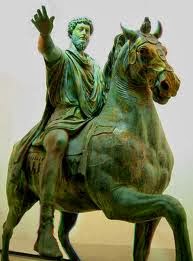
Emperor Marcus Aurelius

I hope to begin the new year by posting a couple of pieces on the book of Ecclesiastes. James Barr said somewhere that this book is the nearest thing we have in Scripture to a work of philosophy, and I think that this is correct.  It is not a great work in philosophy, or anything like that, but it is reflective in a general way, and has some of the style of philosophical reflections. It's tone, or the mind-set of the author, gives it a resemblance to the Meditations of Marcus Aurelius, a Roman Emperor influenced by the Stoics, as I shall try to show. Besides this, we'll look at the teaching of the book, and at its relation to the New Testament.  And there is stuff about our relation to time which I cannot resist.

These posts are to celebrate a commentary of Ecclesiastes by a long-standing friend, Melvin Tinker, to be published in 2014. I have not yet read it - a treat in store - but my guess  is that he and I will have a good deal in common. At least we'll both agree that the book has a positive message. It is not the work of a sour-minded and disillusioned king, but of someone who has come to realise where true satisfaction in this life is found, and what its limits are.

In addition to this I shall draw attention to a new book on antinomianism by Mark Jones, another friend, who with Joel Beeke is the author of A Puritan Theology. And I've discovered  that there's more to be said about  the 'dual-aspect theism' that we encountered in the work of  Rob Lister and his mentor Bruce Ware. In fact I think I've ferreted out another  source if not the source of this idea that God is a duality, making it possible (it is said) to hold that  God is timeless and also in time. For besides Rob Lister and his mentor Bruce Ware there is Scott Oliphint (in his book God With Us: Divine Condescension the Attributes of God (2012)) and his mentor John Frame. Frame offers the view in The Doctrine of God (2005) as well as in his recent one-volume Systematic Theology. So he another source. 

Nobody is to be accused of plagiarism! There is no issue of 'accountability'.  The claim that this view is an 'improvement' upon classical theism and God's relation to the creation marks a significant change in the way that we are bidden to think of God, when judged by the Reformed tradition. With such an 'improvement' we get the treat of having our cake and eating it, but at the price of  choking , as we shall see.

Beyond this, who can tell?  Even thinking that we can see as far as the first few months of the year is stretching things.

Nevertheless  I hope  that you and your families enjoy a Happy New Year!

Saturday, November 30, 2013

‘Calvinism’– Latte? Cappucino? Americano?


 "When I use a word," Humpty Dumpty said, in rather a scornful tone, "it means just what I choose it to mean—neither more nor less."
  "The question is," said Alice, "whether you can make words mean so many different things."
  "The question is," said Humpty Dumpty, "which is to be master—that's all."

The quotation-marks around ’Calvinism’ in the title are not accidental. We are here primarily concerned  with the issue between Alice and Humpty Dumpty. The issue is about the words, not things, and in particular the fact that various people have various things to say about the word 'Calvinism' at present - its legitimacy, and what it refers to and may refer to. Words can be fought over. Whoever captures the word,  captures the thing. But frequently the words resist capture.  I shall argue, the word ‘Calvinism’ wriggles freely,  for good or ill. I shall sketch two such attempts at capture, one scholarly, the other rougher, to capture the meaning of ‘Calvinism’. Each fails, as it must. The rougher attempt first.

‘Doctrinal Calvinism’

There are those who are disquieted over the fact that many are claiming the name ‘Calvinism’  for themselves who are Baptists, and many who are charismatics do the same. Shock-horror! Charismatic Baptists? Where will it end? Such people tut-tut like the Dame in a Pantomime. But it is nothing new for people to adopt the name ‘Calvinist’ or ‘Calvinism’ for something narrow than was produced by the copious theological mind of John Calvin. I remember that in my youth , in the damp cellar of a Preston second-hand bookshop, I came across some books in the series called ‘Doctrinal Calvinism’,  published in the nineteenth century. I think that of the two or three titles  I retrieved – I have them no longer, alas - one contained a selection of the writings of Bishop Ezekiel Hopkins, another of John Bunyan, and maybe one of John Howe,  one-time Chaplain to Oliver Cromwell. An Anglican and a Baptist and a Congregationalist, I believe, each ‘doctrinal Calvinists’. To be sure, that title was not a self-description, but one given to them. But it was not an unreasonable title. I remember also for a time possessing the Works of Hopkins, which Thornton’s bookshop in Oxford sold me,  which contained an exposition of the covenants worthy of Witsius. He was Bishop of Londonderry, I believe.

What on earth, then, was doctrinal Calvinism? It was, and is, I think, the soteriology that is to be found in first 20 or so Chapters of the Westminster Confession and which was adopted by the Savoy Confession (or Declaration) of 1658, and the  Baptist Confession of 1689 almost verbatim.  (You can see the 3 confessions compared here. (http://www.proginosko.com/docs/wcf_sdfo_lbcf.html) 

The publishers of the books I mentioned no doubt hoped to tap into this ‘Calvinism’ that was common to people in the C of E and among Dissenters. (And now, perhaps, 'charismatic' is a word that also currently receives the Humpty Dumpty treatment.) A smart marketing ploy, in my view. There is a lot more to these chapters of the Confession than the famous Five Points, of course. The adopting of these parts of Westminster was carried out in the conviction that there is a logically contingent connection between the theological material expressed in these chapters, and ecclesiology, as there is.

Those who raise their eyebrows at such behaviour have the idea that Calvinism is not only a theology but an ecclesiology. Certainly Calvin’s theology comprises not only Book I-III of the Institutes but Book IV as well, the longest book of the four, and it could be argued, the climax of the whole production.  But there is a problem for those who make this claim these days, for embedded within Book IV is an account of the duty of the civil magistrate to uphold the true or Reformed religion from anything in the civil realm that would tend to undermine it, beginning with the outlawing of untrammelled proclamations of other religious teachings, such as those of Rome, or of Faustus Socinus, or of the Jews or Turks. And I don’t think that those who believe that presbyterian church-government is an intrinsic part of Calvin’s theology nowadays routinely think that intolerance of other religions is or ought to be an intrinsic part of the civil magistrate’s duties.  They could say that it is a part of Calvinism, but that they disagree with it. Not the sort of precedent they want to set,  I assume

‘Calvinist’ or ‘Reformed’?

Besides this rather  shrill opposition  to ‘doctrinal Calvinism’ , as a bona fide expression of Calvinism at a more scholarly level, it is increasingly being pointed out  that ‘Calvinism’ is misleading as the name for the theological trajectory of Reformed Orthodoxy. Calvin was a member of a theological team, not a one-man team, nor its captain. What developed after his death in the Reformed Church is no more ‘Calvinism’ than it is ‘Bucerism’ or ‘Zanchism’, even though Calvin achieved a greater prominence than these, for a variety of reasons, not least the prestige of Geneva as a centre of the Reformation.

It is also pointed out that what is misleadingly called ‘Calvinism’ can mean less than the ‘Five Points’, and also more than them in that as Reformed theology developed there were various emphases given to Christian doctrine by different individuals and theological schools. An account of some of these differences in respect of the work of Christ can be seen worked out by Richard Muller with his usual care and erudition in Calvin and the Reformed Tradition: On The Work Of Christ And The Order Of Salvation. So within the parameters set not by Calvin but by the various Reformed Confessions there was a considerable difference in emphasis. Confessions of faith are, after all, political documents.

These claims about the relatively narrow scope of ‘Calvinism’ in Reformed theology are  based on a historiography which pays some attention to lines of sameness as well as of divergence in the teaching of the Reformer. But it recognises that much of the legacy of John Calvin was underdetermined by comparison with the theology that was developed later, theology that even so was indebted to Calvin. Areas of such development are, for example, the decrees of God, and the covenants, and the work of Christ. Calvin cannot be held responsible for theological constructions of his legacy, occurring after his death, any more than, say, Andrew Fuller, who defended the propriety of general invitations of the gospel, can be held responsible for every preaching extravagance that people since  Fuller have thought was an ‘offer of Christ’.  Those who wish to dissent from these scholarly claims will have their work cut out to do so. They will have to present a much more detailed Calvinism than they are used to doing.

Which is yours?
 But note that this restriction of ‘Calvinism’ to Calvin’s own theology, and resistance to its extension to the theology that engendered the Confessions, and to which they in turn gave rise, begins with the earlier view of ‘Calvinism’, the ‘Calvinism’ of the Five Points and of doctrinal Calvinism. (Not the same thing, but each has a solely soteriological emphasis.) The scholarly critique recognises or legitimises that ‘doctrinal Calvinism’ we noted earlier, legitimises it by taking it seriously. Its critique is more scholarly than that of the whingers were noted earlier, but it is a criticism which legitimises what it is a criticism of. Not even scholarship is capable of copyrighting ‘Calvinism’.
So which is yours to be,  the ‘Calvinism’ of the 5 points,  a ‘doctrinal Calvinism’, a ‘Calvinism’ which identifies it with Calvin’s children, who went their own way when the discussion went beyond Calvin himself, or the ‘full package Calvinism’, which is not a full package at all, since Calvin’s view of the magistrate’s role in upholding the Reformed faith has been excised from it? (And in this roll-call 'Neo-calvinism in its various guises has not even been mentioned. )
Whichever it is, no-one can stop you calling your choice ‘Calvinism’. You see, unlike ‘Cadbury’s’ or ‘Chevrolet’ or ‘Calvin Klein’ ’ there is no copyright or  trademark  that covers the use of the word ‘Calvinism’. Any more than with 'inerrancy' or 'justification' or any other central theological term.
Irritating, isn’t it?