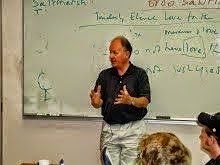
This month I begin the first of a series of four posts on Bishop Tom Wright's book on justification.
I'll say this as a short preface to this series: It's a good thing to have a Bishop of the C of E debating the great things of the gospel. How many English bishops are there? Thirty? Forty? Two hundred? I've no idea. Their sepia features make them merge as one, the whole tribe apparently consumed by Anglican bureaucracy and political correctness
Where is there a theologian among them? Answer: There's one in Durham. So though, as I shall try to show, some of Bishop Tom's ideas on justification are off-centre, and his way of debating these matters is very strange (that is, if the idea is to home in on the truth), who can nonetheless fail to admire the commitment and industry of the man?
Side by side with the four posts on Wright on justification I shall be putting out four drafts of short extracts from a book, Calvin at the Centre, to be published by the Oxford University Press in November. The book is in central respects a sequel to John Calvin's Ideas, (OUP, 2004).
In a post on mental error, 'Hodge and Hymn Singing' I cited three Reformed theologians on the matter, without providing references. I am now in a position to reveal...that these are ....
(1) J.I.Packer, ‘Fundamentalism’ and the Word of God, 1958, 124
(2) Jonathan Edwards, Works, (Yale edition), 19, 242
(3) John Owen, Works, ( ed. Goold), 5, 163-4
Wednesday, July 01, 2009
Wright in General
Wright's Approach
Tom Wright’s new book on justification (Justification: God’s Plan and Paul’s Vision (London SPCK)) is a good read, and with much of it I found myself nodding in agreement . He writes in a ‘jolly hockeysticks’ way, with great verve, enthusiasm and self-confidence. But he is not so good at running towards the goal. He is not as clear as he ought to be about identifying the matters at issue; what is common ground, and what is, or are, the remaining problems. In this first post on his book I shall try to show some of why this is.
Those expecting a blow by blow engagement with John Piper’s book on Wright (The Future of Justification) will be disappointed. The strategy is to outflank Piper exegetically - to say: ’If your aim is to see what Paul teaches about justification in its original context, then this is the way to do it, and what he teaches is substantially different from the Reformed view of Paul’s account of justification’. In my view, he does not succeed in showing this. It’s a pity, though, that the author did not have time to extend the same courtesy to John Piper as Piper extended to him, to invite him to read the MS in draft. Had he done so he might have saved himself some trouble. One has the feeling, occasionally, that Bishop Wright is not content unless he has the last word. One reason for the failure of the outflanking strategy is a straightforward but irritating misunderstanding, which a dose of Piper would have cured, as we shall see in due course.
The theocentricity of his approach, and the material on covenant history are excellent. – Of many statements, there is this:
At this point he could have been reading John Calvin. Wright seems never to have heard of covenant theology, writing as if the phrase is his, (222) and as if the idea of a single history, a single covenant of grace, is a fresh exegetical insight. He’s also good on grace and faith.(184)
On tradition, the bishop has curious views. He routinely thinks of tradition as constraining what is thought in the present, and so anything ‘traditional’ must be rejected or at least viewed with suspicion. (eg 135, 223, and many other places.) But a rejection of all tradition seems unbiblical and in any case tends to lead to the reinvention of the wheel. Why does a traditional view, if it is a correct view, not inform and liberate? Belief in the resurrection of Jesus, is that not 'traditional'? He writes of ‘refreshing’ the tradition, and this could mean merely smartening it up, or replacing it with a fresh view. He does not say which. It is as if semper reformanda, together with the mantra that the Lord has yet more light and truth to break forth from his Holy Word, are phrases which warrant a never-ending research project. The idea that we need a continuous stream of fresh readings of Paul, newer and newer new perspectives, is both wearying and scary. (13)
One has also to get over Wright’s understanding of Romans 2. 1 – 16 as being a description of Jew and Gentile believers. But though disagreeing with this view, one can live with it. It was after all Augustine’s view, and so part of the ‘Augustinian tradition’ which Wright elsewhere dismisses. (Augustine, On the Spirit and the Letter, Ch.44)
Faith and Works
I gained three general impressions of a theological nature. One is that the gap between Wright and the classic Reformation view of justification (as expressed by John Piper, for example) seems to be not as great as before. If one presses the logic of Wright’s present position, then the gap is even less. Where the gap has already narrowed is over the question, Are believers justified now? Or are they only justified at the last, on the basis of a whole life? In the new book he writes that the 'future judgment.... corresponds to the present verdict which... is issued simply and solely on the basis of faith’ (165) See also 179, 207-12, 223. But it has to be admitted that Wright wobbles on this, as in 166-7 ‘the verdict on the last day will truly reflect what people have actually done’. The vagueness of the language irritates: 'corresponds to', 'anticipate', 'reflect'. How corresponds to, anticipates, reflects?, one vainly asks.
Nevertheless, despite the wobbles in stating his position, wobbles that could be given a good and a bad sense, this is a change from his Edinburgh paper on justification in which he was clearly striking a different note. There justification was reserved for the final judgement, giving his account a moralistic flavour, which invited one to draw a comparison with Richard Baxter. (See here) But this has to be said: the relation of faith to actions badly needs a clarificatory word from the Bishop’s cathedra to settle this vital question: are Spirit-imbued virtues a sign of faith (à la Epistle of James)? Or do they complete faith, supplement it, fulfil it? These questions cry out for an answer, but answer is there none. A clear sentence of two would have done it. It is this sort of gap that holds up the discussion and the meeting of minds. So where, according to the Bishop, (one is left to wonder) does Paul stand on this issue? And where does the Bishop himself stand? (More on the difficulty in handling the Wright output in the fourth post.)
Imputation
To get to the heart of the second matter, imputation, one first has to negotiate one’s way through a whole tangle of issues. It is clear throughout the book that Wright has a forensic, law-court approach to justification, seeing this clearly in Paul. The second half of the book works this out in great and repetitive detail. The difficulty that arises is over what exactly is imputed and how it is imputed. As we shall see later on Wright has a clumsy and unsympathetic understanding of the Reformed doctrine of the imputation of Christ’s righteousness. It’s hard to say, even at the end, whether Wright has got the picture.
Part of the reason for this failure may be the Bishop's strong belief that God’s righteousness (in Paul) is his covenant faithfulness, that such faithfulness is identical with the character of God’s righteousness, and is not simply an expression of it, or the chief expression of it. And so he repeatedly claims that what God reckons, in law-court fashion, to his people, is what Jesus, the faithful Israelite, achieved for his people in his death and resurrection. Because of what he did they are ‘in the right’. But (for Wright) being in the right cannot be having Christ’s righteousness imputed, since (in that sense) Christ has no righteousness to impute and to suppose otherwise is to be guilty of a ‘category mistake’.
I suspect that this failure to appreciate a deeper sense of God’ s righteousness (which is both a logical and a theological failure) lies at the heart of Wright’s present view of what it is that the judge in court declares the offender to be. But it is not so easy to tell because he has such a weird understanding of what the Reformed view is. (By the way, note the little word ‘moral’, ‘moral righteousness’. It seems no bigger than a man’s hand, but it will turn out to be much larger).
Imputation and fudge
The third matter is Wright’s fudging of the Reformed view. He writes blithely of it involving the transfer of merit from a ‘treasury’. So imputation is the granting of some of Christ’s merit. He says, writing of Paul’s teaching in Galatians, that God’s purposes have been accomplished through the single person of Israel’s faithful representative.
If the imputation of righteousness is the treasury view, what is the imputation of sin? Does Christ get our sin? Is being made sin his being made sinful? (Did the Reformers never think about such points?) The language of the treasury, which I have never met in Reformed theologians, seems more reminiscent of Tetzel than of Luther and Calvin. It must at best be thought of as figurative or analogical language for imputation, and misleading at that.
Such language arises, I believe, because of a generally slap-happy approach to doctrine and its history, resulting in utter unclarity as to just who those Wright refers to as the followers of Augustine, those in his tradition, are intended to be, and especially what the history of Reformed theology in its relation to Augustine looks like. This failure is odd in view of the claim, at the end of he book, that the author is the one who has finally established Reformed theology. (224) One wonders, is he well-informed? Can he be serious?
This lack of seriousness is seen, for example, in comments on Gal. 3.29. He claims that for the ‘old perspective’ no one has even asked the question of why Paul concludes his argument, ‘you are therefore Abraham’s seed’ and not merely ‘you are therefore children of God’. (19) But glancing at John Calvin, we find
Calvin does not ask the question, but he does give an answer that is strongly in accord with Wright’s own answer.
Here’s another sweeping claim - that the doctrine of the imputation of Christ’s righteousness is the central failure of Reformed people. (e.g. 71f.)
‘Much of the post-Augustinian tradition has used ‘justification’ to cover the whole range of ‘becoming a Christian’ from first to last…’ linking with this, in the next paragraph, to John Piper! (71) This tradition is clearly intended to include the Reformers. Or this
There is absolutely no awareness that this is precisely the standard Reformed meaning of ‘imputation’, ‘reckoning’ and ‘count as’; and no recognition that what he then goes on to say about that view is filled with serious misconceptions.
The terms of debate
If a person is participating in a discussion and separating his own view from others' views then two things are needed: he needs to convey a clear sense of what his own view implies and does not imply, and he needs to show that he understands the view or views from which he dissents, representing them with the greatest sympathy and clarity that he can muster. On the matter of justification it is not sufficient to provide the reader with acres and acres of what St. Paul really said. The writer has also to say how this differs from standard Reformed views (if those are the issue) and to do this one needs to set out those views with clarity and sympathy. I don't find this in this book, and the failure lowers visibility. In the course of the next posts we shall from time to time find ourselves surrounded by this swirling mist.
So, beta minus for presentation.
In the next post I shall argue that there are good theological reasons why God’s righteousness cannot mean ‘covenant faithfulness’, (Piper 45, 71) and then, in the post after that I try to show that Wright’s root and branch opposition to the very idea of the imputation of righteousness also lands him in a certain amount of inconsistency. Finally, in the fourth post, I shall re-present the standard Reformed view of the imputation of Christ’s righteousness, showing that it is a clear alternative both to Rome and to Wright's view as presented in his book. I do this in the hope that the differences between his view and the ‘traditional’ Reformed position, which may have already narrowed, may be narrowed further.
Tom Wright’s new book on justification (Justification: God’s Plan and Paul’s Vision (London SPCK)) is a good read, and with much of it I found myself nodding in agreement . He writes in a ‘jolly hockeysticks’ way, with great verve, enthusiasm and self-confidence. But he is not so good at running towards the goal. He is not as clear as he ought to be about identifying the matters at issue; what is common ground, and what is, or are, the remaining problems. In this first post on his book I shall try to show some of why this is.
Those expecting a blow by blow engagement with John Piper’s book on Wright (The Future of Justification) will be disappointed. The strategy is to outflank Piper exegetically - to say: ’If your aim is to see what Paul teaches about justification in its original context, then this is the way to do it, and what he teaches is substantially different from the Reformed view of Paul’s account of justification’. In my view, he does not succeed in showing this. It’s a pity, though, that the author did not have time to extend the same courtesy to John Piper as Piper extended to him, to invite him to read the MS in draft. Had he done so he might have saved himself some trouble. One has the feeling, occasionally, that Bishop Wright is not content unless he has the last word. One reason for the failure of the outflanking strategy is a straightforward but irritating misunderstanding, which a dose of Piper would have cured, as we shall see in due course.
The theocentricity of his approach, and the material on covenant history are excellent. – Of many statements, there is this:
God’s single plan always was to put the world to rights, to set it right, to undo Genesis 3 and Genesis 11, sin and the fracturing of human society which results from that sin and shows it up in its full colours…:to bring about new creation, through Abraham/Israel and, as the fulfilment of the Abraham/Israel shaped plan, through the Messiah, Jesus. (78. See also, for example 26, 73f, 83, 155, 174).
At this point he could have been reading John Calvin. Wright seems never to have heard of covenant theology, writing as if the phrase is his, (222) and as if the idea of a single history, a single covenant of grace, is a fresh exegetical insight. He’s also good on grace and faith.(184)
On tradition, the bishop has curious views. He routinely thinks of tradition as constraining what is thought in the present, and so anything ‘traditional’ must be rejected or at least viewed with suspicion. (eg 135, 223, and many other places.) But a rejection of all tradition seems unbiblical and in any case tends to lead to the reinvention of the wheel. Why does a traditional view, if it is a correct view, not inform and liberate? Belief in the resurrection of Jesus, is that not 'traditional'? He writes of ‘refreshing’ the tradition, and this could mean merely smartening it up, or replacing it with a fresh view. He does not say which. It is as if semper reformanda, together with the mantra that the Lord has yet more light and truth to break forth from his Holy Word, are phrases which warrant a never-ending research project. The idea that we need a continuous stream of fresh readings of Paul, newer and newer new perspectives, is both wearying and scary. (13)
One has also to get over Wright’s understanding of Romans 2. 1 – 16 as being a description of Jew and Gentile believers. But though disagreeing with this view, one can live with it. It was after all Augustine’s view, and so part of the ‘Augustinian tradition’ which Wright elsewhere dismisses. (Augustine, On the Spirit and the Letter, Ch.44)
Faith and Works
I gained three general impressions of a theological nature. One is that the gap between Wright and the classic Reformation view of justification (as expressed by John Piper, for example) seems to be not as great as before. If one presses the logic of Wright’s present position, then the gap is even less. Where the gap has already narrowed is over the question, Are believers justified now? Or are they only justified at the last, on the basis of a whole life? In the new book he writes that the 'future judgment.... corresponds to the present verdict which... is issued simply and solely on the basis of faith’ (165) See also 179, 207-12, 223. But it has to be admitted that Wright wobbles on this, as in 166-7 ‘the verdict on the last day will truly reflect what people have actually done’. The vagueness of the language irritates: 'corresponds to', 'anticipate', 'reflect'. How corresponds to, anticipates, reflects?, one vainly asks.
Nevertheless, despite the wobbles in stating his position, wobbles that could be given a good and a bad sense, this is a change from his Edinburgh paper on justification in which he was clearly striking a different note. There justification was reserved for the final judgement, giving his account a moralistic flavour, which invited one to draw a comparison with Richard Baxter. (See here) But this has to be said: the relation of faith to actions badly needs a clarificatory word from the Bishop’s cathedra to settle this vital question: are Spirit-imbued virtues a sign of faith (à la Epistle of James)? Or do they complete faith, supplement it, fulfil it? These questions cry out for an answer, but answer is there none. A clear sentence of two would have done it. It is this sort of gap that holds up the discussion and the meeting of minds. So where, according to the Bishop, (one is left to wonder) does Paul stand on this issue? And where does the Bishop himself stand? (More on the difficulty in handling the Wright output in the fourth post.)
Imputation
To get to the heart of the second matter, imputation, one first has to negotiate one’s way through a whole tangle of issues. It is clear throughout the book that Wright has a forensic, law-court approach to justification, seeing this clearly in Paul. The second half of the book works this out in great and repetitive detail. The difficulty that arises is over what exactly is imputed and how it is imputed. As we shall see later on Wright has a clumsy and unsympathetic understanding of the Reformed doctrine of the imputation of Christ’s righteousness. It’s hard to say, even at the end, whether Wright has got the picture.
Part of the reason for this failure may be the Bishop's strong belief that God’s righteousness (in Paul) is his covenant faithfulness, that such faithfulness is identical with the character of God’s righteousness, and is not simply an expression of it, or the chief expression of it. And so he repeatedly claims that what God reckons, in law-court fashion, to his people, is what Jesus, the faithful Israelite, achieved for his people in his death and resurrection. Because of what he did they are ‘in the right’. But (for Wright) being in the right cannot be having Christ’s righteousness imputed, since (in that sense) Christ has no righteousness to impute and to suppose otherwise is to be guilty of a ‘category mistake’.
John Piper insists that God requires a moral righteousness of us, and that since we have none of our own God must reckon or impute such a moral righteousness from somewhere else – obviously within this scheme, from the ‘righteousness’ of Jesus Christ . I can see how that works. But ‘righteousness’, within the very precise language of the courtroom which Paul is most clearly evoking, most obviously in Romans 3, is not ‘moral righteousness’. It is the status of the person whom the court has vindicated.’ (71)
I suspect that this failure to appreciate a deeper sense of God’ s righteousness (which is both a logical and a theological failure) lies at the heart of Wright’s present view of what it is that the judge in court declares the offender to be. But it is not so easy to tell because he has such a weird understanding of what the Reformed view is. (By the way, note the little word ‘moral’, ‘moral righteousness’. It seems no bigger than a man’s hand, but it will turn out to be much larger).
Imputation and fudge
The third matter is Wright’s fudging of the Reformed view. He writes blithely of it involving the transfer of merit from a ‘treasury’. So imputation is the granting of some of Christ’s merit. He says, writing of Paul’s teaching in Galatians, that God’s purposes have been accomplished through the single person of Israel’s faithful representative.
But this does not mean that he [Jesus] has ‘fulfilled the law’ in the sense of obeying it perfectly and thus building up a ‘treasury of merit’ which can then be ‘reckoned’ to his people. That scheme, with all its venerable antecedents in my own tradition as well as John Piper’s, always was an attempt to say something which Paul was saying, but in language and concepts which had still not shaken off the old idea that the law was, after all, given as a ladder of good works up which one might climb to impress God with one’s own moral accomplishments’(114, also 201, 134-5 the ‘amassing of a treasury of law-based ‘righteousness’, which a ‘blind alley’ (204, also 205, ‘a category mistake’, ‘legalism’)
If the imputation of righteousness is the treasury view, what is the imputation of sin? Does Christ get our sin? Is being made sin his being made sinful? (Did the Reformers never think about such points?) The language of the treasury, which I have never met in Reformed theologians, seems more reminiscent of Tetzel than of Luther and Calvin. It must at best be thought of as figurative or analogical language for imputation, and misleading at that.
Such language arises, I believe, because of a generally slap-happy approach to doctrine and its history, resulting in utter unclarity as to just who those Wright refers to as the followers of Augustine, those in his tradition, are intended to be, and especially what the history of Reformed theology in its relation to Augustine looks like. This failure is odd in view of the claim, at the end of he book, that the author is the one who has finally established Reformed theology. (224) One wonders, is he well-informed? Can he be serious?
This lack of seriousness is seen, for example, in comments on Gal. 3.29. He claims that for the ‘old perspective’ no one has even asked the question of why Paul concludes his argument, ‘you are therefore Abraham’s seed’ and not merely ‘you are therefore children of God’. (19) But glancing at John Calvin, we find
The conclusion rests on this argument, that Christ is the blessed seed, in whom, as we have said, all the children of Abraham are united. He proves this by the universal offer of the inheritance to them all, from which it follows, that the promise includes them among the children. It deserves notice, that, wherever faith is mentioned, it is always a relation to the promise.
Calvin does not ask the question, but he does give an answer that is strongly in accord with Wright’s own answer.
Here’s another sweeping claim - that the doctrine of the imputation of Christ’s righteousness is the central failure of Reformed people. (e.g. 71f.)
we have undercut in a single stroke the age-old problem highlighted in Augustine; interpretation of ‘justify’ as ‘make righteous’. This has always meant, for Augustine and his followers, that God, in justification, was actually transforming the character of the person, albeit in small, preliminary ways (by, for instance, implanting the beginnings of love and faith within them). The result was a subtle but crucial shifting of metaphors: the lawcourt scene is now replaced with a medical one, a kind of remedial spiritual surgery involving a ‘righteousness implant’ which, like an artificial heart, begins to enable to patient to do thing previously impossible.
‘Much of the post-Augustinian tradition has used ‘justification’ to cover the whole range of ‘becoming a Christian’ from first to last…’ linking with this, in the next paragraph, to John Piper! (71) This tradition is clearly intended to include the Reformers. Or this
There is indeed a sense in which ‘justification’ really does make someone ‘righteous’ – it really does create the righteousness, the status-of-being-in-the right, of which it speaks – but ‘righteousness’ in that law court sense does not mean either ‘morally good character’ or ‘performance of moral good deeds’, but ‘the status you have when the court has found in your favour’. (71)
There is absolutely no awareness that this is precisely the standard Reformed meaning of ‘imputation’, ‘reckoning’ and ‘count as’; and no recognition that what he then goes on to say about that view is filled with serious misconceptions.
The terms of debate
If a person is participating in a discussion and separating his own view from others' views then two things are needed: he needs to convey a clear sense of what his own view implies and does not imply, and he needs to show that he understands the view or views from which he dissents, representing them with the greatest sympathy and clarity that he can muster. On the matter of justification it is not sufficient to provide the reader with acres and acres of what St. Paul really said. The writer has also to say how this differs from standard Reformed views (if those are the issue) and to do this one needs to set out those views with clarity and sympathy. I don't find this in this book, and the failure lowers visibility. In the course of the next posts we shall from time to time find ourselves surrounded by this swirling mist.
So, beta minus for presentation.
In the next post I shall argue that there are good theological reasons why God’s righteousness cannot mean ‘covenant faithfulness’, (Piper 45, 71) and then, in the post after that I try to show that Wright’s root and branch opposition to the very idea of the imputation of righteousness also lands him in a certain amount of inconsistency. Finally, in the fourth post, I shall re-present the standard Reformed view of the imputation of Christ’s righteousness, showing that it is a clear alternative both to Rome and to Wright's view as presented in his book. I do this in the hope that the differences between his view and the ‘traditional’ Reformed position, which may have already narrowed, may be narrowed further.

Augustine and Calvin on the Knowledge of God
In his use of Augustine what Calvin latches onto what, for Augustine, came after the vision, the knowledge of God and of ourselves which it initiated and made possible. Although Calvin looks to the Bishop of Hippo for much of his theological inspiration, or at least for the formulation of it, we need to bear in mind that he is no means an uncritical Augustinian. This often comes out in incidental details. So in his work on predestination, Concerning the Eternal Predestination of God, Calvin notes that Augustine's account of evil as a privation, which he accepts as true, is nonetheless a subtlety 'which does not satisfy many';1 and elsewhere he is critical of Augustine's platonically-influenced account of the creation.
So one line of Calvin's criticism is over the evident or avowed platonism of Augustine. We may also see such filtering of Augustine's thought at work in the way in which Calvin assimilates the Augustinian theme of the interrelatedness of the knowledge of God and of ourselves. But it must also be remembered that Calvin was never in agonies over Manicheism and over what might take its place.
So we should not assume, a priori, that in developing his thoughts on the relation between the knowledge of God and of ourselves, Calvin slavishly follows Augustine. It is obvious that he cannot do that, for we have seen that this theme is an important strand in his discussion of the nature of faith, and the relationship between faith and assurance. And though Augustine discusses the place of faith in justification, and the relation of faith to belief, (as we shall note in Chapter Seven), there is nothing comparable in Augustine to Calvin's discussion of the nature of faith. The Reformation sola fide had intervened, as well as Calvin's genius as a 'theologian of the Holy Spirit'.
For another thing, there appears to be nothing in Calvin's experience that corresponds to what, for Augustine, followed the reading of the books of the Platonists. It is true that Calvin, by comparison with Augustine, was a very reticent, private individual. Nonetheless, he tells us something of his conversion and of other turning points in his life, and from time to time he mentions his own character traits. But even if we were to read portions of the Institutes autobiographically, there is nothing that corresponds in Calvin's experience to Augustine's 'ascent'. We have noted that at the centre of Augustine's experience of 'ascent' to God is both a metaphysical and an epistemological conclusion. As a result, he both learns how to think about God, and is certain of him. Through the use that he makes of these conclusions in the Libero he endeavours to bring them to others in a discursive way. There is nothing like this in Calvin. No vision, and no concern to establish the certainty of God's existence in such a manner.
Nevertheless, in the context of the Reformation and of his polemic against the Church of Rome, Calvin was most certainly interested in certainty, in the assured authority of Holy Scripture and what it teaches, and in the assurance of faith, as we have already noted. Calvin believed that he and all other Christians have certainty, or may have it, through the work of the Holy Spirit illuminating the revealed truth of Holy Scripture.3 But of course he does not discuss the character of this certainty in epistemological vein, carefully comparing it with that incorrigibility that later on Descartes was to claim for his knowledge of himself. Though it is interesting that there is one isolated example of an Augustinian (and by implication a Cartesian) turn of phrase. In his early Psychopannychia (1542) a sustained polemic against the Anabaptist doctrines of post-mortem 'soul-sleep' and of 'mortalism', commenting on Hebrews 11.6 ('they desire a better country') Calvin says,
Calvin here commits himself to 'Necessarily, if A desires, then A exists'. This was, for him, in the case in hand, a refutation of the doctrine of 'mortalism', the belief that at the death of the body the soul also died, albeit temporarily, a refutation drawn from a premise of Holy Scripture. Despite at least one commentator drawing a parallel with Descartes' cogito it would be unwise to ascribe any greater epistemological significance to it than Calvin supplies in the context.5 It is an exaggeration to suppose that 'Both Calvin and Descartes start from an Augustinian premise, namely that personal experience is our gate of access to being. Calvin, however, places the experience of the self in desire rather than, as Descartes does, in thought.' 6 This is to promote an inference from a biblical text into a fundamental epistemic principle. It is not so much the individual experience of desire, but the fact of post-mortem desire, from which Calvin draws the inference that therefore there must be post-mortem awareness.
Further, Calvin's appreciation of divine transcendence was couched in much more negative terms than Augustine's - he stresses the incomprehensibility of God, the 'secrets' of his providence and grace, the fact that we cannot know God 'in himself', and the inscrutability of his will. Calvin was not so much concerned with scepticism as with what does and ought to count as the knowledge of God in the Church. No mere assent, not implicit faith, was sufficient, only explicit trust in God as he is to us, the God of the covenant, the God of promise. So, much of what there was of value for Descartes in Augustine passes Calvin by.
In addition, Calvin differs rather markedly from Augustine in one respect that we have not so far brought out very fully, and this also will be significant when, in the next Chapter, we consider the question of the reception of Descartes and Cartesianism in the Reformed churches. We noted at the beginning of the Chapter that in the opening sentences of the Institutes not only does Calvin assert the importance of the knowledge of God and of ourselves, but he imparts his own distinctive emphasis to this. He finds in our knowledge of God as Creator another source of wisdom. Calvin here opens the door onto a significant difference between Augustine and himself over what I shall call 'worthwhileness', a difference which at the same time brings him nearer to Descartes. We now go on briefly to look at this, and to tease out some of its importance for our theme.
Contrary to a widespread misconception, Augustine certainly had a positive view of the body, and of the physical world in general. It was after all the creation of God, and was originally good. And he had been emancipated from Manichean dualism. Yet he never ceased to be concerned with his own physicality and with what he judged to be its negative impact on his life with God. The external world was also distracting. The lizard on the wall is something that, despite himself, fascinated Augustine. But it is a distraction which results in his mind being filled with 'a mass of empty thoughts',7 not something to be interested in or to wonder at. For Augustine the place of the physical world was an element in a life-long tension, a deep strain in his thought between use and enjoyment, uti and frui; a strain revealed, for example, in human friendship, and over his reaction to the death of his mother Monica. 8
Augustine sets out the distinction between uti and frui in a rather deadpan, matter of fact way in his On Christian Teaching.
Yet things are not always that clear for Augustine
There is enough ambivalence here to have provoked a justifiable scholarly controversy over the relation of uti to frui in Augustine.11
Calvin has a different emphasis. He does not seem to have been plagued by physical temptations as Augustine was, any more than he was attracted by the pull of Platonism, and as a consequence, and as a part of his reaction against the medieval clergy-laity distinction, he himself supported secular disciplines and callings, and emphasised, with Luther, their legitimacy. He was, after all, at one time destined for the law, and then set out to become a Renaissance scholar. In his conversion he does not turn his back on all this, but comes to have a different estimate of it.
At the personal level he did not feel the strain between uti and frui as Augustine did. He was as aware of the dangers of misusing things below, and setting one's affection on things below and not on things above. We shall look at this, and at the different kind of strain that it imposes on Calvin's thought , in Chapter Ten. Nevertheless, in drawing the distinction between 'things below' and 'things above', a distinction he took, of course, from the New Testament,12 and giving overriding importance to the second, Calvin nevertheless recognised the legitimacy of the first in a way that Augustine found it difficult to do. He was comfortable with the everyday world in a way that Augustine never was, not at least after his conversion.
As far as one can tell Calvin finds little or no tension in uti and frui because he thinks, in a fairly straightforward way, that the same things can be both used and enjoyed. This is because he believed that many created things possess features which are at one and the same time both useful and enjoyable, and are designed as such by their Creator. In his treatment of marriage he writes that man may 'enjoy a help-meet for him',13 something that it would be difficult to imagine Augustine saying. In his discussion of the present life and its helps it is striking that Calvin has a positive view of life which goes well beyond regarding it as merely a disposable means to a greater end. There is not only necessity, but delight.
He refers to
Calvin counsels moderation, and enjoyment, not abstinence. Our guide is to discern the end for which God gave us the gifts. They are for our good, not our ruin.
No tension here, then, between use and enjoyment or delight. Certainly not an emphasis upon the first to the exclusion of the second, but moderate enjoyment, moderate delight, as expressed in this amusing passage.
This outlook translates itself into Calvin's regard for secular callings, including those of philosophy, law and medicine, as quaintly expressed in Arthur Golding's translation of part of a sermon on Job.
Calvin and Calvinism, while generally Augustinian in outlook, had a regard for those callings that proved to be the seedbed of modern science, and so of modern industry, an outlook that was quite foreign to Augustine himself. The wisdom of God could be known in these ways also and those who are properly versed in them would become, in their turn, wise. Such wisdom is enjoyable and worth having for its own sake, even though it is eclipsed by God's saving wisdom as revealed in Jesus Christ, the key to which is the fear of God.
1 Concerning the Eternal Predestination of God , (1552), trans. J.K. S. Reid (London, James Clarke and Co., 1961), 169.
2 Comm. on John's Gospel 1.3, perhaps a reference to Book XII of the Confessions.
3 Inst. I.7
4 Psychopannychia, in Selected Works of John Calvin III. 473
5 George Tavard, The Starting Point of Calvin's Theology, (Grand Rapids, Eerdmans, 2000.), 103
6 Tavard, 103
7 Confessions, X 35.57
8 On one aspect of this tension, see Paul Helm, 'Augustine's Griefs' in Augustine's Confessions ed. William E. Mann, (Lanham, Ma., Rowman and Littlefield, 2005)
9 On Christian Teaching, trans. R.P.H. Green (Oxford, Oxford World's Classics, 1997), 9
10 On Christian Teaching , 25
11 For a summary of this see Raymond Canning, 'uti/frui',
in Augustine Through the Ages , ed. Allan D Fitzgerald, (Grand Rapids, Eerdmans,
1999)
12 Inst. III.10.2
13 Inst. II.8.41
14 Inst. III.10.1
15 Inst. III.10. 1
16 Inst. III.10.2
17 Inst. III.10.3
18 Sermons of Maister John Calvin, upon the Book of Job, trans.Arthur Golding (London, 1574; repr. in facsimile, Edinburgh: Banner of Truth Trust, 1993), 477
Augustine, who is excessively addicted to the philosophy of Plato, is carried along, according to custom, to the doctrine of ideas; that before God made the world, he had the form of the whole building conceived in his mind; and so the life of those things which did not yet exist was in Christ, because the creation of the world was appointed in him. But how widely different this is from the intention of the Evangelist we shall immediately see.2
So one line of Calvin's criticism is over the evident or avowed platonism of Augustine. We may also see such filtering of Augustine's thought at work in the way in which Calvin assimilates the Augustinian theme of the interrelatedness of the knowledge of God and of ourselves. But it must also be remembered that Calvin was never in agonies over Manicheism and over what might take its place.
So we should not assume, a priori, that in developing his thoughts on the relation between the knowledge of God and of ourselves, Calvin slavishly follows Augustine. It is obvious that he cannot do that, for we have seen that this theme is an important strand in his discussion of the nature of faith, and the relationship between faith and assurance. And though Augustine discusses the place of faith in justification, and the relation of faith to belief, (as we shall note in Chapter Seven), there is nothing comparable in Augustine to Calvin's discussion of the nature of faith. The Reformation sola fide had intervened, as well as Calvin's genius as a 'theologian of the Holy Spirit'.
For another thing, there appears to be nothing in Calvin's experience that corresponds to what, for Augustine, followed the reading of the books of the Platonists. It is true that Calvin, by comparison with Augustine, was a very reticent, private individual. Nonetheless, he tells us something of his conversion and of other turning points in his life, and from time to time he mentions his own character traits. But even if we were to read portions of the Institutes autobiographically, there is nothing that corresponds in Calvin's experience to Augustine's 'ascent'. We have noted that at the centre of Augustine's experience of 'ascent' to God is both a metaphysical and an epistemological conclusion. As a result, he both learns how to think about God, and is certain of him. Through the use that he makes of these conclusions in the Libero he endeavours to bring them to others in a discursive way. There is nothing like this in Calvin. No vision, and no concern to establish the certainty of God's existence in such a manner.
Nevertheless, in the context of the Reformation and of his polemic against the Church of Rome, Calvin was most certainly interested in certainty, in the assured authority of Holy Scripture and what it teaches, and in the assurance of faith, as we have already noted. Calvin believed that he and all other Christians have certainty, or may have it, through the work of the Holy Spirit illuminating the revealed truth of Holy Scripture.3 But of course he does not discuss the character of this certainty in epistemological vein, carefully comparing it with that incorrigibility that later on Descartes was to claim for his knowledge of himself. Though it is interesting that there is one isolated example of an Augustinian (and by implication a Cartesian) turn of phrase. In his early Psychopannychia (1542) a sustained polemic against the Anabaptist doctrines of post-mortem 'soul-sleep' and of 'mortalism', commenting on Hebrews 11.6 ('they desire a better country') Calvin says,
Here our opponents argue as follows: If they desire a heavenly country, they do not already possess it: We, on the contrary, argue; If they desire, they must exist, for there cannot be desire without a subject in which it resides. 4
Calvin here commits himself to 'Necessarily, if A desires, then A exists'. This was, for him, in the case in hand, a refutation of the doctrine of 'mortalism', the belief that at the death of the body the soul also died, albeit temporarily, a refutation drawn from a premise of Holy Scripture. Despite at least one commentator drawing a parallel with Descartes' cogito it would be unwise to ascribe any greater epistemological significance to it than Calvin supplies in the context.5 It is an exaggeration to suppose that 'Both Calvin and Descartes start from an Augustinian premise, namely that personal experience is our gate of access to being. Calvin, however, places the experience of the self in desire rather than, as Descartes does, in thought.' 6 This is to promote an inference from a biblical text into a fundamental epistemic principle. It is not so much the individual experience of desire, but the fact of post-mortem desire, from which Calvin draws the inference that therefore there must be post-mortem awareness.
Further, Calvin's appreciation of divine transcendence was couched in much more negative terms than Augustine's - he stresses the incomprehensibility of God, the 'secrets' of his providence and grace, the fact that we cannot know God 'in himself', and the inscrutability of his will. Calvin was not so much concerned with scepticism as with what does and ought to count as the knowledge of God in the Church. No mere assent, not implicit faith, was sufficient, only explicit trust in God as he is to us, the God of the covenant, the God of promise. So, much of what there was of value for Descartes in Augustine passes Calvin by.
In addition, Calvin differs rather markedly from Augustine in one respect that we have not so far brought out very fully, and this also will be significant when, in the next Chapter, we consider the question of the reception of Descartes and Cartesianism in the Reformed churches. We noted at the beginning of the Chapter that in the opening sentences of the Institutes not only does Calvin assert the importance of the knowledge of God and of ourselves, but he imparts his own distinctive emphasis to this. He finds in our knowledge of God as Creator another source of wisdom. Calvin here opens the door onto a significant difference between Augustine and himself over what I shall call 'worthwhileness', a difference which at the same time brings him nearer to Descartes. We now go on briefly to look at this, and to tease out some of its importance for our theme.
Contrary to a widespread misconception, Augustine certainly had a positive view of the body, and of the physical world in general. It was after all the creation of God, and was originally good. And he had been emancipated from Manichean dualism. Yet he never ceased to be concerned with his own physicality and with what he judged to be its negative impact on his life with God. The external world was also distracting. The lizard on the wall is something that, despite himself, fascinated Augustine. But it is a distraction which results in his mind being filled with 'a mass of empty thoughts',7 not something to be interested in or to wonder at. For Augustine the place of the physical world was an element in a life-long tension, a deep strain in his thought between use and enjoyment, uti and frui; a strain revealed, for example, in human friendship, and over his reaction to the death of his mother Monica. 8
Augustine sets out the distinction between uti and frui in a rather deadpan, matter of fact way in his On Christian Teaching.
There are some things which are to be enjoyed, some which are to be used, and some whose function is both to enjoy and use. Those which are to be enjoyed make us happy; those which are to be used assist us and give us a boost, so to speak, as we press on towards our happiness, so that we may reach and hold fast to the things which make us happy. And we, placed as we are among things of both kinds, both enjoy and use them; but if we choose to enjoy things that are to be used, our advance is impeded and sometimes even diverted, and we are held back, or even put off, from attaining things which are to be enjoyed, because we are hamstrung by our love of lower things. 9
Yet things are not always that clear for Augustine
When you enjoy a human being in God, you are enjoying God rather than that human being. For you enjoy the one by whom you are made happy, and you will one day rejoice that you have attained the one in whom you now set your hope of attaining him.... Yet the idea of enjoying someone or something is very close to that of using someone or something together with love.10
There is enough ambivalence here to have provoked a justifiable scholarly controversy over the relation of uti to frui in Augustine.11
Calvin has a different emphasis. He does not seem to have been plagued by physical temptations as Augustine was, any more than he was attracted by the pull of Platonism, and as a consequence, and as a part of his reaction against the medieval clergy-laity distinction, he himself supported secular disciplines and callings, and emphasised, with Luther, their legitimacy. He was, after all, at one time destined for the law, and then set out to become a Renaissance scholar. In his conversion he does not turn his back on all this, but comes to have a different estimate of it.
At the personal level he did not feel the strain between uti and frui as Augustine did. He was as aware of the dangers of misusing things below, and setting one's affection on things below and not on things above. We shall look at this, and at the different kind of strain that it imposes on Calvin's thought , in Chapter Ten. Nevertheless, in drawing the distinction between 'things below' and 'things above', a distinction he took, of course, from the New Testament,12 and giving overriding importance to the second, Calvin nevertheless recognised the legitimacy of the first in a way that Augustine found it difficult to do. He was comfortable with the everyday world in a way that Augustine never was, not at least after his conversion.
As far as one can tell Calvin finds little or no tension in uti and frui because he thinks, in a fairly straightforward way, that the same things can be both used and enjoyed. This is because he believed that many created things possess features which are at one and the same time both useful and enjoyable, and are designed as such by their Creator. In his treatment of marriage he writes that man may 'enjoy a help-meet for him',13 something that it would be difficult to imagine Augustine saying. In his discussion of the present life and its helps it is striking that Calvin has a positive view of life which goes well beyond regarding it as merely a disposable means to a greater end. There is not only necessity, but delight.
For if we are to live, we must use the necessary supports of life; nor can we even shun those things which seem more subservient to delight than to necessity. We must therefore observe a mean, that we may use them with a pure conscience, whether for necessity or for pleasure. 14
He refers to
some good and holy men who, when they saw intemperance and luxury perpetually carried to excess, if not strictly curbed, and were desirous to correct so pernicious an evil, imagined that there was no other method than to allow man to use corporeal goods only in so far as they were necessaries: a counsel pious indeed, but unnecessarily austere; for it does the very dangerous thing of binding consciences in closer fetters than those in which they are bound by the word of God.15
Calvin counsels moderation, and enjoyment, not abstinence. Our guide is to discern the end for which God gave us the gifts. They are for our good, not our ruin.
Now then, if we consider for what end he created food, we shall find that he consulted not only for our necessity, but also for our enjoyment and delight. Thus in clothing, the end was, in addition to necessity, comeliness and honour; and in herbs, fruits and trees besides their various uses, gracefulness of appearance and sweetness of smell….The natural qualities of things themselves demonstrate to what end, and how far, they may be lawfully enjoyed. Has the Lord adorned flowers with all the beauty which spontaneously presents itself to the eye, and that sweet odour which delights the sense of smell, and shall it be unlawful for us to enjoy that beauty and that odour? What? Has he not so distinguished colours as to make some more agreeable than others? Has he not given qualities to gold and silver, ivory and marble, thereby, rendering them precious things above other metals and stones? In short, has he not given many things a value without having any necessary use? 16
No tension here, then, between use and enjoyment or delight. Certainly not an emphasis upon the first to the exclusion of the second, but moderate enjoyment, moderate delight, as expressed in this amusing passage.
For many are so devoted to luxury in all their senses, that their mind lies buried; many are so delighted with marble, gold, and pictures that they become marble-hearted - are changed as it were into metal, and made like painted figures. The kitchen, with its savoury smells, so engrosses them that they have no spiritual savour. 17
This outlook translates itself into Calvin's regard for secular callings, including those of philosophy, law and medicine, as quaintly expressed in Arthur Golding's translation of part of a sermon on Job.
Furthermore, they have also trades and handicraftes: as, one is a Baker, another a Plowman, another a Shoomaker, and another a Clothyer: and all these trades are the gift of God, and they be common, as well to the unbelievers, as to the faythfull whome God thath inlightened by his holy spirite.... to speake of some handicraft: before a man come to be cunning in the occupation, he shall find straunge things: yea there are some woorkes that require such cunning, as ye would woonder. Howe is this possible to be done, will men say? Howe coulde men know where Golde lyeth in the earth? Beholde men make Salt of water. Howe commeth that to passe? Surely even bycause God has given men the skill.... When wee once knowe these things, wee thinke them not straunge at all, but yet is it God that hath given us the skill of them...18
Calvin and Calvinism, while generally Augustinian in outlook, had a regard for those callings that proved to be the seedbed of modern science, and so of modern industry, an outlook that was quite foreign to Augustine himself. The wisdom of God could be known in these ways also and those who are properly versed in them would become, in their turn, wise. Such wisdom is enjoyable and worth having for its own sake, even though it is eclipsed by God's saving wisdom as revealed in Jesus Christ, the key to which is the fear of God.
1 Concerning the Eternal Predestination of God , (1552), trans. J.K. S. Reid (London, James Clarke and Co., 1961), 169.
2 Comm. on John's Gospel 1.3, perhaps a reference to Book XII of the Confessions.
3 Inst. I.7
4 Psychopannychia, in Selected Works of John Calvin III. 473
5 George Tavard, The Starting Point of Calvin's Theology, (Grand Rapids, Eerdmans, 2000.), 103
6 Tavard, 103
7 Confessions, X 35.57
8 On one aspect of this tension, see Paul Helm, 'Augustine's Griefs' in Augustine's Confessions ed. William E. Mann, (Lanham, Ma., Rowman and Littlefield, 2005)
9 On Christian Teaching, trans. R.P.H. Green (Oxford, Oxford World's Classics, 1997), 9
10 On Christian Teaching , 25
11 For a summary of this see Raymond Canning, 'uti/frui',
in Augustine Through the Ages , ed. Allan D Fitzgerald, (Grand Rapids, Eerdmans,
1999)
12 Inst. III.10.2
13 Inst. II.8.41
14 Inst. III.10.1
15 Inst. III.10. 1
16 Inst. III.10.2
17 Inst. III.10.3
18 Sermons of Maister John Calvin, upon the Book of Job, trans.Arthur Golding (London, 1574; repr. in facsimile, Edinburgh: Banner of Truth Trust, 1993), 477
Subscribe to:
Posts (Atom)